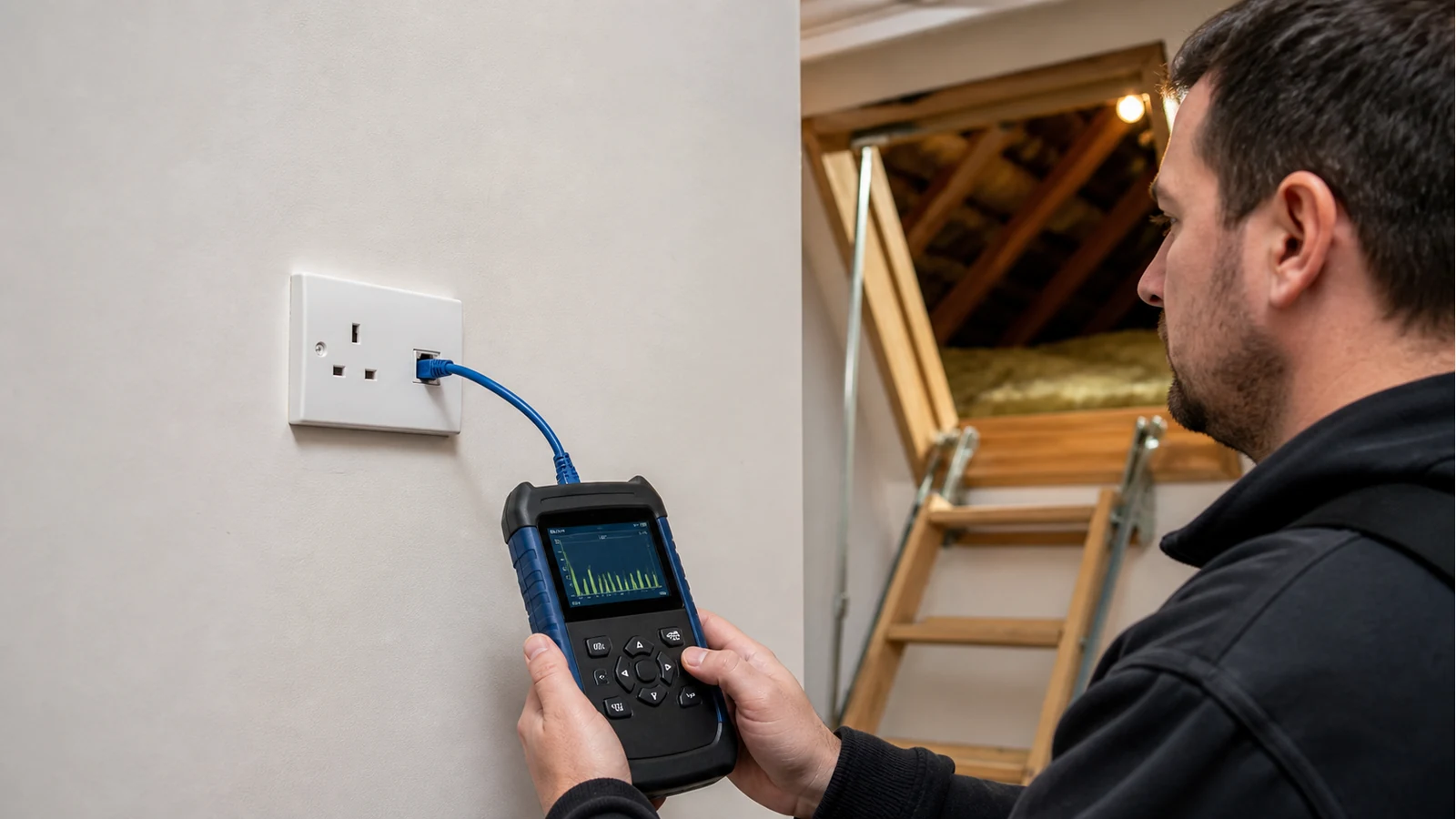
How To Test Ethernet Cable Length Uk
Direct answer: test the cable with wiremap first, then use a length or distance-to-fault reading to estimate how far the copper run goes or where an open or short may sit. Treat the metre figure as a diagnostic clue, not as a Category 6 certification result.
This matters most when the cable disappears into a loft, plasterboard wall, garden-office duct or under-floor route. Guessing “about ten metres” is not much help when one room has no link light and opening the wrong wall would be expensive.
Start with the fault you can prove
A network cable tester workflow normally starts by checking pin-to-pin continuity and wiremap. The Fluke Networks network cable tester guide describes wiremap and length or distance-to-fault as common copper test functions. In practical terms, wiremap tells you whether the pairs reach the far end correctly; length testing helps you judge where the run or break probably is.
Length reading checklist
- Disconnect active equipment. Remove the router, switch, camera or access point from the cable before using a passive cable-test mode.
- Expose both ends where possible. Plug the main tester into the wall plate or patch-panel end and the remote into the far end.
- Run wiremap first. If the cable reports open, short or crossed conductors, fix the termination before trusting a length figure.
- Compare the reading with the route. A loft-to-study drop may reasonably be longer than the straight-line room distance because it follows joists, walls and service voids.
- Record the result. Write down room, panel port, approximate length and any open/short distance shown.
When a metre reading is useful
Length is useful when it changes the next physical action. A reading that suggests the break is close to the wall plate points you towards the keystone or plug. A reading far down the run makes buried damage, a crushed cable or an outdoor joint more plausible. UK test-equipment retailers describe TDR fault locators as tools that use signal reflections to estimate fault distance; see this Test Meter TDR fault locator overview.
When it is not enough
A handheld length reading does not prove that a link passes ISO, TIA or manufacturer performance limits. If a builder, landlord, commercial client or main contractor requires a formal handover certificate, you need a proper certifier and a test report. For home troubleshooting, though, length plus wiremap is often enough to decide whether to re-terminate, open a small access point or escalate.
Useful extra: switch-side TDR
Some enterprise switches expose pair diagnostics from the switch port. A public Cisco switch TDR command walkthrough shows why network teams sometimes think in “distance to pair fault” even without a handheld tester. Home users should still avoid assuming their ISP router has the same diagnostic feature.
Proceed or stop?
Proceed if you only need to locate a likely termination or cable fault in a home or small-office run. Stop and hire a certification-capable installer if the job needs a formal pass report, if the fault is intermittent under load, or if the cable may be near unsafe electrical work.