How To Test Open Short Ethernet Cable Uk
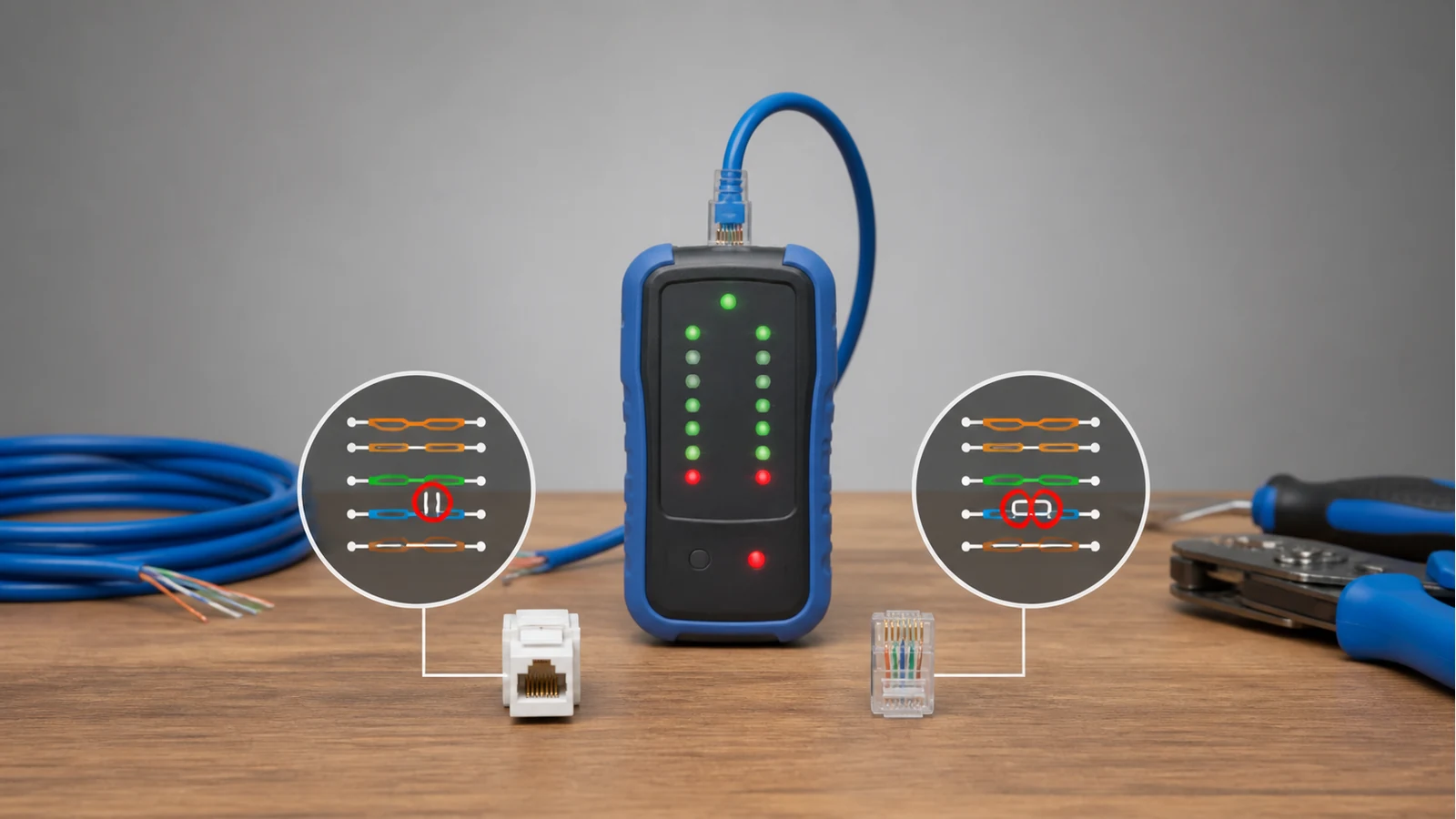
Direct answer: an open means one or more conductors are not continuous to the far end; a short means conductors are touching each other; a miswire means pins land in the wrong order; a split pair can pass simple continuity but still fail Ethernet performance. Treat the tester result as a pointer to the next termination check, not as a reason to chase walls immediately.
This is the fault pattern UK DIYers, landlords and small-office IT people hit after fitting keystones, crimping RJ45 plugs or moving a patch panel.
Fault result to next action
| Wiremap result | Likely cause | First action |
|---|---|---|
| Open on one pin or pair | Loose IDC punch-down, broken conductor, poor crimp | Re-terminate both accessible ends and inspect the copper seating. |
| Short between pins | Stray copper strands, crushed plug, damaged cable | Inspect the plug or keystone first; then check for cable damage if it remains. |
| Miswire | Wrong pin order or mixed A/B termination | Choose T568A or T568B consistently for that link and re-terminate. |
| Split pair | Correct pin continuity but wrong twisted-pair grouping | Re-terminate to the correct colour-pair layout; do not rely on LED continuity alone. |
Why a wiremap tester beats guesswork
Wiremap testers are intended to catch pin-to-pin faults such as opens, shorts, miswires and split pairs. This wiremap tester explanation gives the basic workflow: connect the main unit and remote, then read which conductors arrive correctly.
Where a multimeter helps and where it does not
A multimeter can prove simple continuity if you know exactly what you are doing, but Ethernet cabling is about pairs, not only copper touching copper. The multimeter limits for Ethernet cable testing guide explains why split-pair issues can be missed by continuity-only checks. That does not make a multimeter useless; it means it is the wrong primary tool for structured cable diagnosis.
Before you blame the wall
- Remove short patch leads from the test and check the fixed link directly where possible.
- Re-punch the keystone or remake the plug if the fault is at a newly terminated end.
- Check both ends use the same wiring scheme.
- If the same pair still reports open after clean re-termination, use length or distance-to-fault before opening plaster.
What a pass does not mean
A basic pass is not a formal Category certification. The Fluke Networks network cable tester guide separates everyday tester functions from deeper certification work. For a home office, a wiremap pass plus a stable link may be enough; for a commercial handover, ask for a certifier report.
Related next read
If the tester points to a possible hidden break, the Ethernet cable length testing guide explains how metre readings can narrow the search.